What ZettelFlow wrote¶
ZettelFlow writes to your vault in a dozen places: a flow creates a note, a step declares a satellite beside it, a property hook sets frontmatter on a note you were not looking at, giving a canvas a role moves it, and installing a system from the gallery creates a handful of files.
Until 3.6 none of that was written down. The answer to "what did that flow just do?" was to open the notes and look.
Now every write leaves a fact. This page is what that record is, what it deliberately is not, and where it lives.
3.3 changed the shape of this. The panel that read the record — What ZettelFlow changed — is gone (#511). Nobody opened it, and every thought typed in the Lab landed in the record it read, so an afternoon of thinking could evict the flow writes you would actually want to take back.
Undo did not go with it. It moved to the moment: a flow now offers the same thirty-second notice a hook always did, which is when you still remember what you meant and the only moment you would notice that a third note was touched at all. One offer, one path, no panel.
And the record then had nothing to outlive but that offer, so it is in memory: two minutes, never written to disk. No retention policy, no settings field, no
data.jsongrowth. A reload empties it.The honest consequence: a flow you regret an hour later is no longer reversible from inside the plugin. That was already true for hooks by decision (#455); it is now true for everything.
The record¶
One entry per change, newest first:
| Field | What it holds |
|---|---|
kind | note-created · file-created · file-moved · properties-set · content-appended · content-replaced · task-toggled |
path | what was written |
from | where a moved file came from |
origin | who did it: a flow (and its step), a hook (and its property), an action, a gallery install, or you |
batch | the id every write of one action shares |
before / after | for a property change: the touched keys, as they were and as they were left |
task | for task-toggled (a box ticked in a Base dashboard's Tasks panel, #635): the line, the box before → after, and a fingerprint of the line — never its text |
at | when |
No note content, ever¶
There is no field for a note's body, and a test asserts there is not. (The one exception, stated below, is the text of an append — ZettelFlow's own output, capped at 2,000 characters.) The record is deliberately not a second copy of your vault — a copy would have none of your vault's protections and all of its contents.
This is affordable because of how undo works: a note ZettelFlow created is taken back by moving it to Obsidian's trash, which needs no copy of the body. A property change is taken back by writing the previous value, which is exactly what before holds — and only for the keys that actually changed.
The one thing that cannot be taken back is therefore content-replaced: overwriting an existing file. It is still recorded, because what ZettelFlow changed is worth answering even where take it back has no answer.
Two minutes, and a ceiling¶
The record is kept in memory for two minutes (WRITE_WINDOW_MS), and never more than 200 entries (MAX_WRITES) — whichever comes first. Its only reader is the thirty-second undo offer, so it only has to outlive one. Neither is configurable, nothing is written to disk, and a reload empties it.
Page ink (the Reader's, #790) is one entry per save of a book's ink file: the first save is a file created, which undo by batch can take back; later saves are replacements, recorded but not undoable, like every overwrite. Taking strokes back is the ink palette's own undo. A Keep as note is one batch: the ink note, its drawing and the ink file's save together.
A batch is what one action did¶
A flow that creates a note, writes a satellite beside it and sets two properties has performed four writes and one action. The batch id is what says so, and it is the reason undo can take back the thing you actually did rather than one file of it.
flowchart LR
    NB[the flow] --> R[the recorder]
    SAT[its satellite] --> R
    PROPS[the properties it set] --> R
    R --> BATCH[(one batch)]
Batches nest: an action inside a flow belongs to the flow's batch, while the record still names the action as the origin of that particular write — the outer batch is the unit you undo, the inner origin is the accurate answer to who wrote this file.
Where the record is taken¶
Not at the call sites. Two services are the only places ZettelFlow writes, and the record is taken inside them:
FileService—createFile,createFileOnce,writeFile,writeBinaryFile,modifyandmoveFile.- A map of content created from an Explore selection (#486) is an ordinary recorded
note-created, attributed tomap-of-content— previewed before it is written, never overwriting, and taken back with its batch like anything else. FrontmatterService— every property write in the plugin passes through one privateprocessFrontMatter, which is the only moment at which the previous value still exists. The record is taken there, as a diff.
Taking the diff rather than a copy has a consequence worth stating: a hook that sets a property to the value it already had has changed nothing, so it leaves no record — and later, offers no undo for a change it did not make.
A guardrail test (test/architecture/plugin/vaultWriteCoverage.test.ts) derives the writing methods from the source and fails when one of them does not record. deleteFile is the single named exception: undoing a deletion would mean keeping the body, and Obsidian's trash already holds the file.
One door, and the test that keeps it shut¶
The reason a record like this rots is the writer that arrives later and does not join it — and vault.modify is one import away from anywhere. So there is a second guardrail (test/architecture/plugin/vaultWriteSeam.test.ts) that scans the whole of src/ and fails on any direct call to the vault's mutating API outside the two services:
vault.create · vault.createBinary · vault.modify · vault.modifyBinary · vault.delete · vault.trash
fileManager.renameFile · fileManager.trashFile · fileManager.processFrontMatter
createFolder is not on the list: a folder is structure, not content, and there is nothing to record or take back about one.
This is the same move FnConstructor made for running code — one home, and a list of callers derived from the source rather than copied into a test. Eight places were reaching past the services when the rule went in; they now go through FileService.modify / createFile / deleteFile or FrontmatterService.update, which is the public door onto the recorded processFrontMatter.
Two modules that are unit-tested against a fake vault take a small writer port with a real, service-backed default (onboardingService, and applyUndo itself) — the port is the seam, not a way around it.
Who is writing¶
The origin travels with the batch: withWriteBatch({ kind, ref, step }, work) is set once by whoever starts the unit of work, and every write underneath inherits it. A call site never invents a label, and a write that nobody claimed is recorded as unattributed rather than dropped — an unexplained write is still a fact.
Taking it back¶
The record has exactly two readers, and both are an offer in the moment:
- the thirty-second notice a flow or a hook leaves when it writes (#511), whose Undo takes back that one batch;
-
the notice a gallery install leaves (#799), whose Undo takes the whole install back — the flow it displaced included, keeping any file you changed since.
-
the Reader's Ctrl/⌘+Z (#810), which takes back, one press at a time, the writes this reading offered an Undo for — the same run as the Undo button, guarded once, so nothing is taken back twice. A write backed by a batch is limited by the record's two-minute window like any other; a highlight's own Undo saves the thought back and has no such limit. It never reads a batch another surface wrote.
A shared copy of a PDF (#842) is one file-created in a reader-share batch, written by FileService.createBinaryFileOnce — the binary create that returns nothing, and touches nothing, when the path is taken, so a copy is never written over another file. The sheet's Undo (and the Reader's Ctrl/⌘+Z) sends it to the trash. The original PDF is only read, so there is nothing of it to take back.
A renamed book's follow (#810) is a recorded batch with no Undo of its own: it is the mechanical consequence of your rename, and renaming the book back makes everything follow back.
There is no panel and no mode that lists the record. Home's modes are Home, Cultivate and Think (see surfaces). Before 3.3 a Home mode, What ZettelFlow changed, listed the batches; before that, the wizard kept a second list of the notes it built, which never mentioned the satellite beside the note, the frontmatter a hook set while you were elsewhere, or the canvas that moved when you gave it a role. Both are gone, and the history setting is dropped on load.
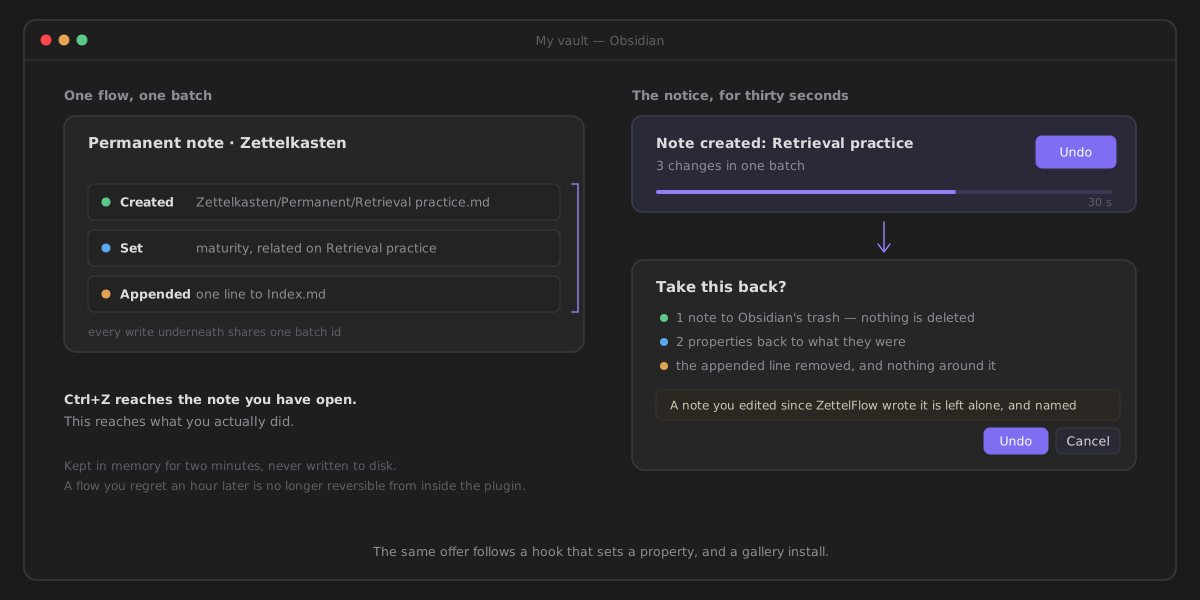
Undo takes a batch, not a file¶
Ctrl+Z reaches the note you have focused. This reaches what you actually did:
- Notes and files ZettelFlow created go to Obsidian's trash. Nothing is deleted.
- Properties it set go back to their previous values — and a key it added is removed again, because "before" recorded its absence.
- A file it moved goes back where it came from.
- Text it appended is removed, exactly that text and nothing around it.
It is previewed, and it refuses¶
Before anything happens, a confirmation states the counts and names the notes. Cancelling changes nothing.
And undo refuses rather than overwriting your work:
| Situation | What happens |
|---|---|
| You edited the note after ZettelFlow wrote it | Left alone, named, with when it changed |
| A property no longer holds what ZettelFlow left | Left alone, naming the key |
The write was an overwrite (content-replaced) | Left alone: the old content was never kept |
| The file is already gone | Skipped quietly — there is nothing to take back |
When some of a batch is out of reach, the rest is still planned and offered as an explicit undo the rest — a partial undo is a decision you take, never one taken for you.
A batch that has been taken back is marked as such, and is not offered again.
A hook's change, undoable in the moment¶
Of everything ZettelFlow writes, a property hook's write is the one that surprises people: it fires on a note you were not looking at, and the only trace is a notice that is gone in five seconds.
So the notice carries an undo, live for thirty seconds. It says which property changed, on which note. Taking it does exactly what the panel would do for that batch. Ignoring it is the normal case — it is a notice, never a modal, and after thirty seconds it goes quietly: no second notice, no badge, no counter. The same undo stays in the record.
A hook that set a property to the value it already had changed nothing, recorded nothing, and offers nothing. That is the common case for an idempotent hook, and it stays silent.
The one place content is kept¶
An append is the exception to no note content: the record keeps the exact text ZettelFlow added, up to 2,000 characters, because removing it again is the only way an append can be reversed. It is ZettelFlow's own output, capped, and gone with the record. Past the cap the write is recorded as an overwrite instead, and cannot be taken back.
Undoing is not a write¶
The undo's own operations are performed with recording off. Putting a note back is not a new thing ZettelFlow did to your vault, and recording it would leave you an undo you could undo.
Recording never changes the write¶
The rule the script run log established holds here too: observing must never change what was observed. recordVaultWrite cannot throw into a write path — every branch is wrapped, and a recorder that fails logs a warning and gives up. A record that breaks a note is worse than no record.
Capability disclosure¶
| Capability | Used |
|---|---|
| File system — write | The record itself, capped, in the plugin's own settings — and, only on an explicit, previewed undo: moving created notes to the trash and restoring previous property values |
| Network | No |
| Clipboard | No |
| Script execution | No |
| AI | No |
Under §XII, a change record is a mechanical account of what already happened: no severity, no ranking, no advice about whether a write was a good idea.
README vocabulary for this page: See what will change.