Review this flow¶
Nothing about a flow was checked until it ran. A flow could be saved, shared as a system and installed by someone else while a file step pointed at a deleted note — which throws FatalError in the middle of someone writing — or while steps were unreachable, dead ends, or two options read exactly alike.
The review is a reading of the recorded graph. The Review tab of the canvas dock (bottom right, beside Legend and Rehearse, #686) says how many findings it has — or shows a check when there are none; opening it lists them, and clicking one selects and centres the node it is about.
What it reports¶
| Finding | What it states |
|---|---|
| The note is gone | A file step points at a note that no longer exists. The flow will stop there. |
| No start | No step is marked as the root, so the flow cannot begin. |
| Several starts | More than one root — legitimate, and worth knowing. |
| Nothing points at it | The step is unreachable from any root, so the flow never arrives. |
| Dead end | The step ends the flow without asking, writing or filing anything. |
| Two options read the same | Two sibling exits say the same words: the person picks blind. |
| A gate on a key nothing writes | A condition waits on a frontmatter key no step in this flow writes — it can only come from the note you start on. |
What it is not¶
- Not a score. No number, no quality, no ranking of flows. Every finding is a structural fact about what is recorded, plus what that fact implies.
- Not blocking. Nothing stops you saving, running or sharing a flow with findings. A half-built flow is legitimate work in progress.
- Not a fixer. The review never edits a flow. The finder module imports nothing at all, and a guardrail test asserts it (
flowFindings.test.ts). - Not Health. Health is about the vault's knowledge; this is about one flow's structure. Different objects, different homes.
Nothing destructive in silence¶
- A file step whose note is gone is marked on the node itself (a note is gone badge), without opening the panel — it is the one finding that throws at run time.
- Applying an installed template over a configured step now shows what will change before it is written: one line per field, what it says now and what it would say. Cancelling changes nothing.
- Deleting a node is Obsidian's own action, and ZettelFlow does not wrap it: intercepting a destructive canvas internal to cancel it is a worse risk than the one it avoids, and Obsidian's undo already covers the mistake. What ZettelFlow does instead is notice: the moment a deletion orphans steps, the Review tab's count rises and each orphan is named as nothing points at it.
How it is built¶
application/notes/flowFindings.ts— pure: a flow graph in, findings out. Unit-tested per finding, including the clean flow (empty result) and the case where another step in the same flow writes the key a gate reads.zettelkasten/review/readFlow.ts— the impure half: resolves each node's settings (the same reader the exits use), asks the vault whether a file step's note still exists, and builds the graph withcanvasEdgesoverflowAdjacency(#408) — the same adjacency the wizard walks, so a group's children count as options here too.zettelkasten/review/canvasEdges.ts— one graph reader shared by the review and the rehearsal. It hands over the raw arrow label; who resolves the gate and the words is the exits' business (#427), in one place, so a flow whose conditions still live on its labels reads exactly as it runs.FlowReviewExtension— the dock tab and its panel oncanvas.wrapperEl, every canvas access feature-detected and removed on unload (§VI).
Rehearse the flow¶
The only way to find out what a flow did was to run it on a real note. Authors tested by making throwaway notes and deleting them — which is why half-finished flows ship, and why a branch that can never open survives for months.
Rehearse walks your own flow, in the dock's Rehearse tab. The walk reads as a stepper: a check on each step behind you, the current one marked you are here, and a last row saying what comes next depends on what you choose (#686).
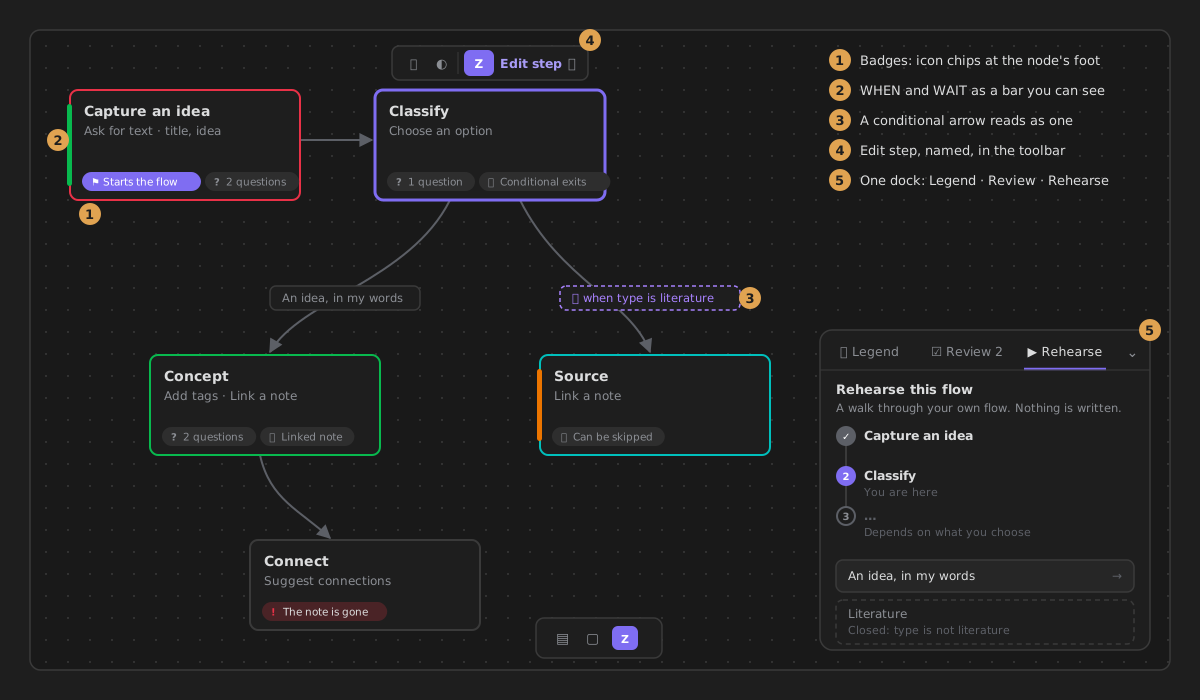
It:
- it asks where to start: a canvas usually holds several flows (four groups on one board is normal), and guessing the first one found would be a guess;
- it walks the graph the wizard walks — outgoing arrows for a box, and the boxes inside a group for a group, since that is how
childrensOfreads a canvas; - you take the options you would be offered, and the path is traced on the canvas — the current node outlined, the walked ones dashed;
- a closed branch is shown with its reason, the same sentence the wizard says to the person writing a note (
explainBranch, one phrasing shared by both); - you supply the frontmatter a gate would read, as a form, because a rehearsal with an empty context only ever takes one path;
- side-effecting actions — script, AI — are listed as "what would run", named, never executed. Pretending to run a script safely would not be an honest answer;
- it ends on the note the walk would have produced: the merged body, the frontmatter keys, where it would be filed, and the linked note (#419) it would also create.
Nothing is written. No note, no folder, no frontmatter, no draft, no history entry. That is not a promise, it is the shape of the code: the walk is a pure module whose imports are asserted by a test — conditionEvaluator, branchVisibility, stepExits, previewAssembly, and nothing else. Leaving the rehearsal removes every class it added; the selection is never touched.
If the canvas internals cannot be annotated, the rehearsal still runs — it just stays in the panel, and says so in the log.
Rehearsing a system you have not installed (#438)¶
The walk and the review work on a plain graph, and a community .zftemplate is that graph: the canvas JSON plus each step's markdown, all of it inside the bundle. So the gallery can answer what would this do to my vault? before anything exists.
Try it in a system's dialog:
- the review first — steps nothing points at, dead ends, options that read alike, a gate on a key nothing writes — so a half-built system is visible before it lands;
- then the walk: the options it would offer, why a branch is closed, the frontmatter you can supply to open another one, and the note it would produce;
- and the what would run list: script and AI actions are named, never executed. That rule matters more here than anywhere else — this is code from the internet.
Nothing is created and nothing is read from the vault: the step contents travel inside the template, the frontmatter parser is injected, and a test asserts the module imports neither FileService nor FrontmatterService nor obsidian. Install stays one click away, and a system with findings is still installable — the gallery informs, it does not gate.
Scans that remember (#461)¶
Three places in ZettelFlow read more than they need. They were checked one by one rather than assumed, and only two turned out to be worth changing:
| Place | Verdict |
|---|---|
WorkflowEventEngine.scanTriggers() | Partly cached already. canvas.flows.update() has been mtime-keyed since #226, so an unchanged canvas is not re-parsed. What was re-derived on every rebuild is each flow's roots — including a file read plus a frontmatter lookup per file node. Now computed once per loaded canvas. |
| The library's find who uses it (#448) | The real problem. It read every canvas in the vault with cachedRead, unbounded, with no way to stop it — the one place that could genuinely hang. Now a bounded, yielding scan that reports what it covered. |
flowsWithRole in the settings panel | Deliberately left alone. It walks Obsidian's in-memory file tree over three small _ZettelFlow folders; there is no I/O and the cost is bounded by the number of flows, not by the size of the vault. A cache here would add invalidation risk to buy nothing. |
A search states its scope¶
A search that quietly truncates produces a confident wrong answer, so the result always says how much it actually covered — "searched 214 canvases", "stopped after 2,000 canvases — there may be more", or "cancelled after 12 canvases". One unreadable file is counted, never allowed to lose the rest.
Why the roots cache needs no invalidation¶
A Flow object is replaced whenever its canvas changes on disk (#226). The object is the revision, so caching on the instance is correct by construction — the same reasoning as the model-revision memo in Knowledge State.
README vocabulary for this page: Rehearse a flow.